


Cross-Threaded Spindle: Keeping Things in Order on the Winch
Cross-threaded spindles play a key role in the winches of deep-sea research vessels. The Antarctic Ocean holds valuable information about Earth’s history and the impact of climate change. In temperatures below -50°C, amid storms and choppy seas, research winches rotate, lowering measuring probes, containers, or tools on special cables to the ocean floor at depths of 5,000 meters. Once the investigations are complete, these winches haul the equipment back up to the deck.
“If we simply let the special cable come up onto the winch without any further ado, the cable would get tangled up like a mess,” points out Hatlapa Service Manager Heinz Garbers. “There are tons of weight hanging on the cable. The cable coils would slip against each other on the winch and get tangled up. A special cable like that, which costs several hundred thousand euros, would be damaged.” Since its founding by Max Hatlapa in 1919, Hatlapa Uetersener Maschinenfabrik, located in the Pinneberg district near Hamburg, has been equipping “big ships” all over the world with compressors, winches, and steering systems. Today, 330 employees generate annual revenue of approximately 140 million euros. Eighty percent of the marine equipment produced is exported. The most important market for this medium-sized global player is Asia. With branches in Cyprus, Shanghai, and Singapore, the company maintains a presence close to its customers.
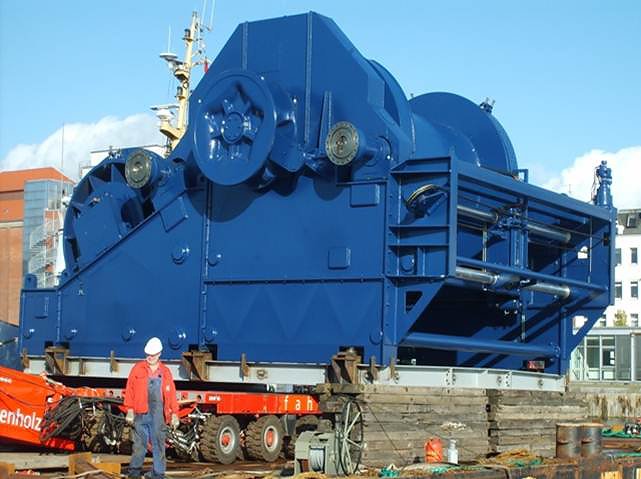
“Using the cross-thread spindle, we wind the cable onto the smooth drum, layer by layer,” says Garbers. The special cable being wound is slowly moved back and forth along the reel. The speed of this back-and-forth movement is matched to the winch’s rotational speed so that cable turns are laid precisely against one another on the winch. This back-and-forth movement is provided by one or more cross-threaded spindles, which—as the name suggests—have both right-hand and left-hand threads. The winch houses the cross-threaded spindles in its frame parallel to the winch axis and drives them to perform the precisely coordinated rotational movement. The right-hand and left-hand threads on the spindles cause a runner to move back and forth, to which the guide roller for the unwound specialty cable is attached.

Proven in rough seas
The carriage reverses automatically at the end of the cross-threaded spindle. “This means we don’t need limit switches or spindle speed reversal, which only enhances reliability in rough sea conditions,” Garbers assures us. The winches can withstand temperatures as low as –50°C and remain operational down to –30°C. Saltwater flooding is not a problem, but icing is. “That’s why the winches are increasingly being installed in large rooms below deck,” Garbers explains.
The research winches last a ship’s lifetime—that is, 30 to 40 years. Bernd Farysch of the Laeisz shipping company confirms this: “All technical equipment on a ship requires maintenance and inspections in rough seas. The research winches cause no problems.” The technical inspector for the shipping company that operates several German research vessels, such as the “Polarstern,” says that research winches are typically part of the ship’s permanent equipment. To fulfill special assignments, clients can also have additional winches installed on the ship prior to a research voyage.
“Over the past few years, we have equipped every German ship with research winches,” says Garbers. That amounts to a total of 64 winches, all of which use exclusively Bornemann cross-threaded leadscrews. This is no coincidence. Managing Director Hans Gereke-Bornemann emphasizes that earning customer trust is his company’s primary goal. “We strive to be perceived as a reliable partner to our customers and are proud of our long-term relationships with our numerous clients,” says Gereke-Bornemann. With this philosophy, he successfully aligns his company with the core business principles of trust, responsibility, and reliability upheld by customer Hatlapa. For the production of cross-threaded spindles with diameters greater than 50 millimeters, Bornemann-Gewindetechnik has developed a specialized machine that enables both cost-effective and specification-compliant spindle manufacturing. Units consisting of much larger Hatlapa winches and Bornemann spindles are used in other applications such as offshore wind power and oil drilling platforms. Martin Thurau/ee
The supplier
For 25 years, Bornemann-Gewindetechnik in Delligsen near Hildesheim has been manufacturing threads in all special shapes, as well as turned and milled parts, with a staff of 40 working in a 3,800-square-meter facility. The company’s product range also includes heavy-duty support rollers in quantities ranging from one to one hundred. To this end, the company operates its own toolmaking department. All machinable materials are used as raw materials. In addition, the company offers repair services for defective spindles. Standard sizes for threaded spindles range in diameter from 10 to 180 millimeters and extend up to a length of six meters.